
Closing the nutrient loop
Fish farming generates nutrient-rich wastewater and solid waste that, if not properly managed, can contribute to environmental pollution. However, these waste streams also contain valuable resources that can be recovered and reused. Integrating fish production with plant cultivation and other biological processes offers opportunities to reduce waste while diversifying aquaculture production.
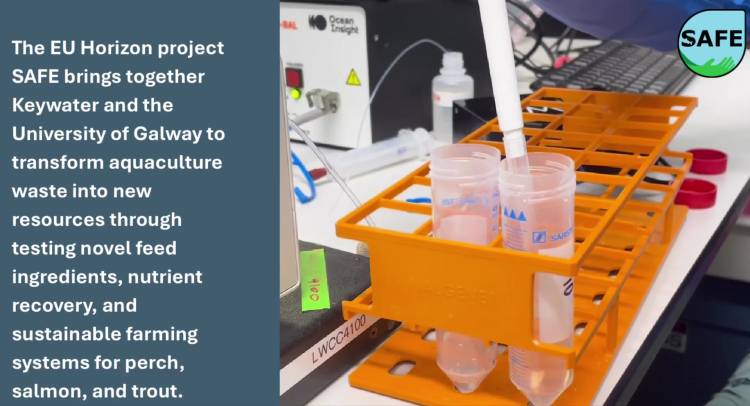
In a new video from the SAFE project, project partner Keywater Fisheries demonstrates how these principles are being applied at its facility in Cloonloogh, County Sligo. Through the integration of recirculating aquaculture systems (RAS), aquaponics, and vermiculture, the company is exploring ways to transform waste from European perch farming into valuable resources for plant production.
Producing European perch in recirculating systems
Keywater Fisheries focuses on the cultivation of European perch (Perca fluviatilis), a freshwater species whose potential for commercial aquaculture is being explored within SAFE.
At the facility, juvenile perch are raised in warm-water recirculating units designed to maintain suitable conditions for fish growth while limiting water consumption.
Water from the production units passes through a series of treatment stages, including mechanical filtration, protein skimming, and ultraviolet (UV) treatment, before being returned to the fish-rearing system. This process helps remove waste particles and maintain water quality while allowing much of the water to be reused.
Although recirculation reduces the need for continuous water replacement, the filtration process produces nutrient-rich residues that must be managed. Keywater is investigating how these materials can be recovered and used in other parts of the farm rather than treated solely as waste.
Recovering nutrients from aquaculture waste
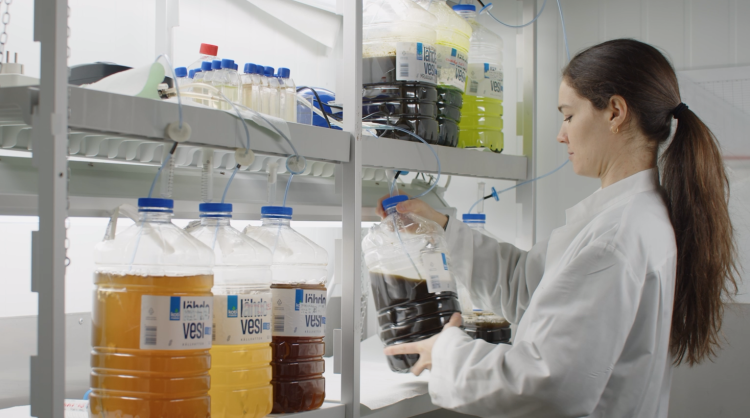
An important part of Keywater’s work involves collecting the solid waste retained by the filtration system.
The nutrient-rich material is recovered from the RAS filters, prepared for storage, and frozen for subsequent use as a potential fertiliser for crops. This creates an opportunity to recover nutrients from fish production and redirect them towards plant growth.
In addition to solid waste, nutrient-rich water from aquaculture can support plant cultivation. By recovering both liquid and solid waste streams, the farm is exploring how resources that would otherwise require disposal or further treatment can contribute to other productive activities.
This approach forms part of integrated multi-trophic aquaculture, in which different organisms and production processes are connected to make more efficient use of available nutrients.
Connecting fish farming with plant production
The video also highlights Keywater’s aquaponic experiments, in which nutrients originating from fish farming are used to support the cultivation of vegetables and other crops.
Greenhouse growing areas contain a variety of plants, including leafy vegetables and climbing crops. These experiments illustrate how aquaculture-derived nutrients can contribute to plant growth while creating opportunities to diversify farm production beyond fish.
Integrating aquaculture and horticulture may also strengthen local food production by allowing farms to generate additional agricultural products using resources already available within the production system.
Rather than viewing fish farming and crop cultivation as separate activities, Keywater’s approach explores how the two can complement each other, with nutrients recovered from one process becoming inputs for another.
Vermiculture: turning organic waste into valuable castings
Another component of Keywater’s circular approach is the use of worms to break down organic material.
Through vermiculture, worms decompose organic residues and transform them into nutrient-rich castings, which can be used to improve growing media and support plant cultivation.
The video demonstrates the worms and their growing environment, illustrating how biological decomposition can become part of nutrient recovery. By processing organic waste, including material derived from fish production, worms offer another pathway for converting residual resources into products with potential agricultural value.
Combining vermiculture with aquaponics and fish production creates opportunities for nutrients to circulate between different activities within the farm.
Towards more circular freshwater aquaculture
Within SAFE, Keywater Fisheries contributes practical experience in European perch production and the development of integrated multi-trophic aquaculture systems.
Its work demonstrates how recirculating fish production can be connected with crop cultivation and biological waste processing. Rather than relying exclusively on conventional waste disposal, the farm is exploring ways to recover nutrients and create additional value from aquaculture residues.
These approaches have the potential to reduce nutrient losses, improve resource efficiency, and diversify farm outputs. Further assessment is needed to establish their environmental and economic performance at different production scales.
Watch the SYKE Technology Readiness video on Youtube: [VIDEO LINK]
More information about the SAFE project is available at https://projectsafe.eu/.
The SAFE project has received funding from the European Union’s Horizon Europe research and innovation programme under Grant Agreement No. 101084549.