
Wastewater from recirculating aquaculture systems (RAS) contains nutrients that could be recovered and used to produce new biomass. Finding ways to make use of these resources is an important part of developing more circular aquaculture systems, reducing waste and creating alternatives to conventional fish-feed ingredients.
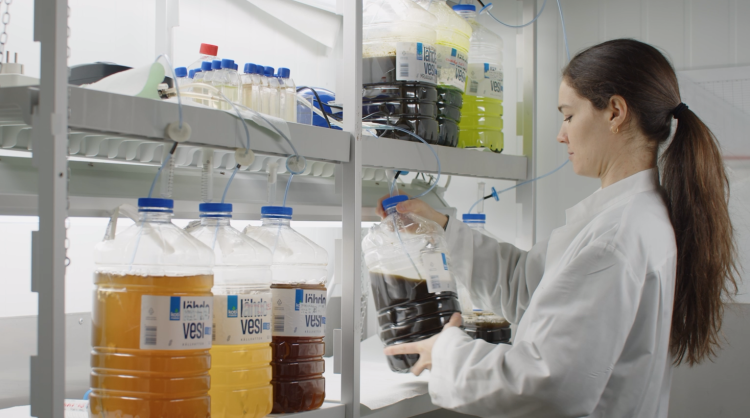
In a new video from the SAFE project, the Finnish Environment Institute (SYKE) demonstrates how treated process water from a Finnish rainbow trout farm can be used to cultivate microalgae. At its Marine Research Laboratory, SYKE has developed a cultivation process that combines nutrient recovery with the production of microalgal biomass containing valuable fatty acids.
Preparing aquaculture wastewater for microalgal cultivation
The process begins with water from a freshwater recirculating aquaculture system. Although this water contains nutrients suitable for microalgal growth, it can also contain other organisms, including ciliates and flagellates, that may interfere with cultivation.
To address this, SYKE uses a sequence of filtration steps, passing the water through filters with pore sizes of 5, 1 and 0.2 micrometres. The filtered water is then treated with ultraviolet C (UVC) radiation to reduce contamination before entering the cultivation system.
The treated water serves as a growing medium for the diatom Phaeodactylum tricornutum. This species was selected for its rapid growth and its high content of polyunsaturated fatty acids, particularly eicosapentaenoic acid (EPA), an omega-3 fatty acid of interest for fish nutrition.
However, the nutrients already present in the process water are not sufficient on their own. Phosphorus and certain trace elements, including manganese, must be supplemented to support microalgal growth.
Cultivating and harvesting the microalgae
At SYKE’s Marine Research Laboratory, microalgae are cultivated in cylindrical reactors with a capacity of 320 litres each. The cultivation temperature is maintained at approximately 20°C, with continuous illumination and aeration. Carbon dioxide is also added when necessary to regulate pH.
After approximately three weeks, the cultures reach sufficient density for their first harvest.
A particularly interesting feature of Phaeodactylum tricornutum is its ability to release extracellular polymeric substances. These compounds help the microalgal cells aggregate and settle, allowing concentrated biomass to be collected after aeration has been stopped for several hours.
By using this natural settling mechanism, SYKE can reduce the energy required for biomass harvesting compared with more energy-intensive separation methods.
The cultivation process also operates in a semi-continuous mode. After harvesting, fresh RAS process water is introduced, allowing cultivation to resume. Subsequent harvests can then take place at intervals of approximately one to two weeks.
Producing biomass for fish-feed research
Beyond producing microalgal biomass, SYKE aims to enhance its nutritional properties. Following the initial harvesting stage, the collected microalgae undergo further cultivation under nitrogen-limiting conditions for up to five days. This encourages the production of long-chain polyunsaturated fatty acids, including EPA.
The resulting biomass is concentrated through centrifugation, frozen and dried. The dried material is then vacuum-packed to prevent lipid oxidation and preserve its quality for subsequent use.
Within SAFE, this biomass contributes to research into alternative fish-feed ingredients. The approach demonstrates how nutrients contained in aquaculture process water can be redirected into the production of potentially valuable biomass rather than remaining an underutilised residual stream.
SYKE’s work illustrates an important element of SAFE’s circular-economy approach: connecting aquaculture waste management with the development of new biological resources. By combining water treatment with microalgal cultivation and efficient harvesting methods, the project is exploring opportunities to make freshwater aquaculture more resource-efficient.
Watch the SYKE Technology Readiness video on Youtube: [VIDEO LINK]
More information about the SAFE project is available at https://projectsafe.eu/.
The SAFE project has received funding from the European Union’s Horizon Europe research and innovation programme under Grant Agreement No. 101084549.