
Fish grading is an essential but demanding part of aquaculture production. Separating fish according to size helps farmers manage stocking densities and maintain suitable growing conditions. However, deciding when to grade, which production units to prioritise and where fish should be transferred requires careful planning. Poorly timed grading can result in unnecessary handling, while delays may lead to overcrowding and increased pressure on fish welfare.
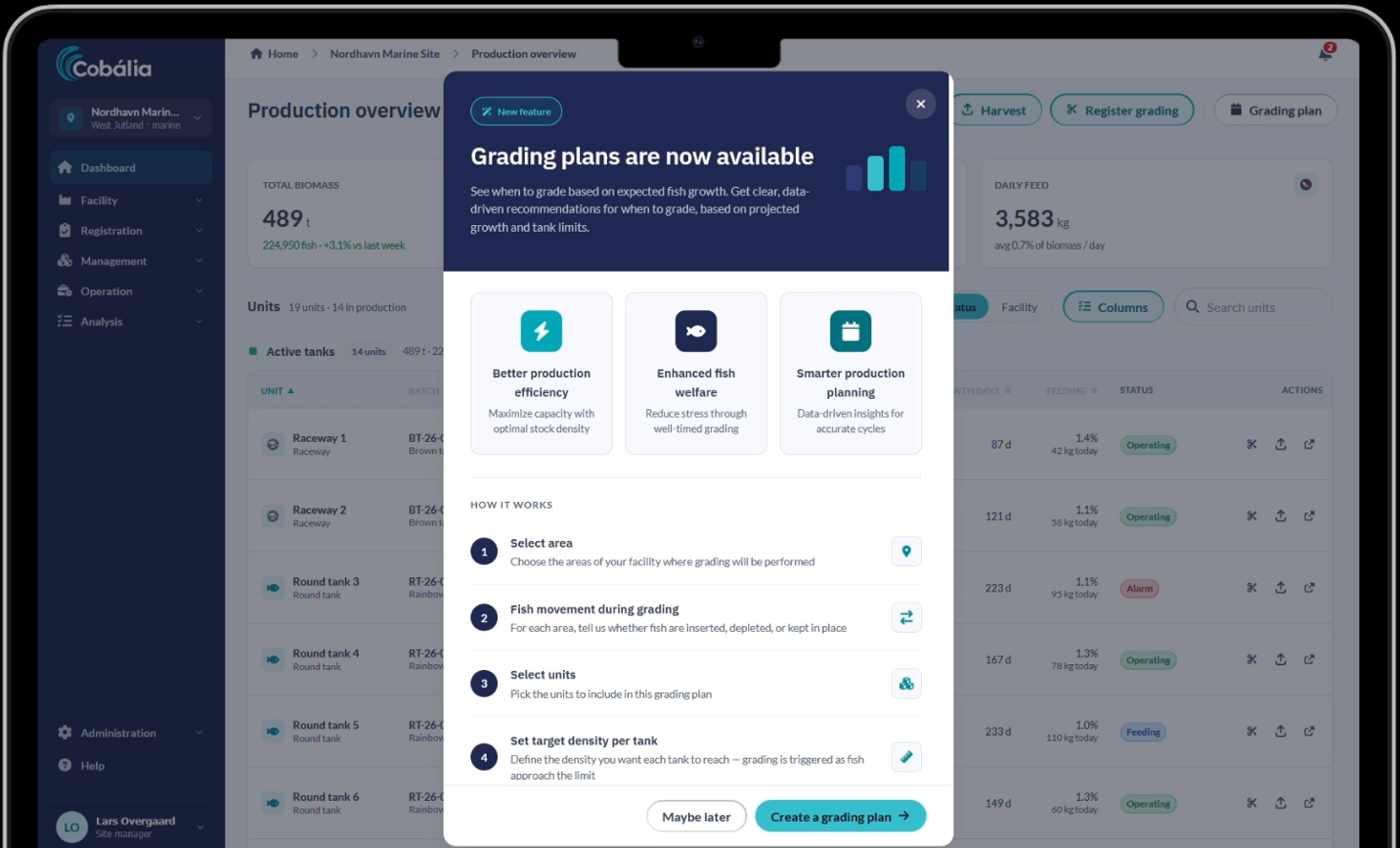
In a new Technology Readiness video from the SAFE project, Danish technology partner OxyGuard International demonstrates its Intelligent Grading feature within Cobália, a digital aquaculture management platform. The tool uses projected fish growth and stocking-density limits to support more informed decisions about when and how grading should take place.
From reactive management to predictive planning
Traditionally, grading decisions depend heavily on farm observations, experience and assessments of current fish size and stocking density. However, as fish continue to grow, conditions within production units can change significantly between grading operations.
Cobália’s Intelligent Grading feature takes a forward-looking approach. By considering expected fish growth and predefined density limits, the system helps farmers anticipate when grading will become necessary rather than waiting until stocking densities approach critical levels.
This allows grading activities to be incorporated into production planning and helps farmers prepare for upcoming operations.
Building a grading plan
The process begins with the selection of the relevant production areas. Farmers then specify whether fish will be introduced, removed or remain within the selected areas during grading. This information allows the system to account for planned fish movements. Next, users select the individual production units to be included in the plan. Each unit contains information about the fish population and current stocking density, providing the basis for subsequent calculations.
Farmers can then establish a target stocking density for each unit. These thresholds are central to the planning process, as they determine when projected fish growth is expected to create a need for grading.
By combining this information, Cobália provides a structured way to plan grading operations across multiple production units.
Adapting grading to production priorities
One of the features demonstrated in the video is the possibility of selecting different grading strategies according to the farm’s operational priorities. Farmers can choose a balanced-growth approach, which schedules grading shortly before density limits are reached, allowing fish to continue growing between operations. Alternatively, the system can prioritise the most densely stocked units to address potential welfare concerns, or focus on units where grading is already overdue.
Users can also define the planning period, choosing between six, twelve or eighteen months. This allows the system to support both shorter-term operational decisions and longer-term production planning. These options give farmers flexibility to adapt the grading schedule to the needs of their facility rather than relying on a single fixed approach.
Turning projections into practical operations
Once the parameters have been established, Cobália generates a proposed grading schedule based on projected fish growth and the selected strategy. The resulting plan identifies upcoming grading events and provides information on the expected number of fish, their size categories and the production units to which they should be transferred.
This information can help farm managers anticipate equipment and staffing requirements while coordinating fish movements between units. The platform also provides an overview of upcoming and overdue grading activities, allowing users to identify operations that require attention.
Importantly, the system serves as a planning and decision-support tool. The proposed schedule provides information that farmers can use alongside their practical experience and knowledge of on-site conditions.
Digital management for more sustainable aquaculture
Within SAFE, OxyGuard contributes expertise in digital aquaculture management through its Cobália platform. The project aims to improve the environmental performance and economic viability of freshwater aquaculture, including through better monitoring and management of production systems. Although the video demonstrates the grading feature using a sea-cage production example, the underlying principle of using growth projections and stocking-density information to support operational decisions is relevant to aquaculture management more broadly.
Better planning has the potential to reduce unnecessary handling, support fish welfare and help farmers use available production capacity more efficiently. However, these benefits depend on the accuracy of the underlying data and how the recommendations are applied in practice. OxyGuard’s Intelligent Grading feature illustrates how digital decision-support systems can translate production information into practical management plans, contributing to the development of more efficient and informed aquaculture operations.
Watch the OxyGuard Technology Readiness video on Youtube: [VIDEO LINK]
More information about the SAFE project is available at https://projectsafe.eu/.
The SAFE project has received funding from the European Union’s Horizon Europe research and innovation programme under Grant Agreement No. 101084549.