
When people picture modern aquaculture, they may imagine large tanks, sophisticated monitoring systems and highly automated farms requiring substantial investment. This can create the impression that aquaculture is an expensive, technology-intensive industry dominated by large corporations.
But this picture represents only part of the sector.
Around the world, aquaculture supports millions of small-scale producers, family businesses and local communities. From traditional freshwater ponds to small family-operated farms, aquaculture can operate at very different scales and with very different levels of technology.
This diversity makes aquaculture not only an important source of aquatic food, but also an important contributor to livelihoods, local economies and food security.
Aquaculture comes in many shapes and sizes
There is no single model for aquaculture.
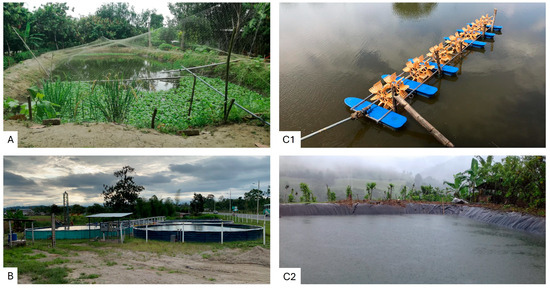
Fish and other aquatic organisms can be produced in ponds, tanks, raceways, cages and recirculating aquaculture systems, among many other production methods. The appropriate system depends on the species being farmed, local environmental conditions, available resources, market demand and the economic circumstances of producers.
Some operations use sophisticated monitoring and automation. Others rely on relatively simple production systems and the knowledge accumulated by farming families and communities over generations.
This distinction matters because discussions about the future of aquaculture often focus heavily on technological innovation. Innovation is important, but sustainable aquaculture cannot be understood exclusively through the lens of large, highly technological farms.
Small-scale producers are also part of that future.
A sector supporting millions of livelihoods
The global importance of aquaculture has increased enormously over recent decades. According to the Food and Agriculture Organization of the United Nations (FAO), aquaculture has become a crucial contributor to global aquatic food production and provides employment and livelihoods for millions of people.
Many of these activities take place in small-scale and family-operated businesses, particularly in Asia and Africa.
For these producers, aquaculture is more than a commercial industry. It can provide household income, employment and food while creating economic activity throughout local value chains.
Fish farms require feed, equipment, transport, processing and veterinary and technical services. Their products are sold through wholesalers, retailers, restaurants and local markets. Consequently, the economic contribution of a farm can extend well beyond the people directly employed in producing the fish.
This makes aquaculture particularly relevant to rural and coastal development, where maintaining viable businesses and employment opportunities can be challenging.
Small-scale aquaculture matters in Europe too
The importance of smaller aquaculture enterprises is not restricted to developing economies.
Europe also has a long tradition of small and medium-sized aquaculture businesses, including family-operated farms producing trout, carp and other freshwater species.
These enterprises contribute to regional economies while maintaining knowledge, infrastructure and production traditions that have developed over generations.
Freshwater aquaculture can be particularly closely connected to rural communities. Fish ponds and farms can form part of local landscapes and economies while supplying regional markets with locally produced food.
However, smaller producers can also face significant challenges. Regulatory complexity, rising energy and feed costs, access to finance, competition and the investment required to introduce new technologies can all make innovation more difficult for small businesses.
If the transition towards more sustainable aquaculture is to succeed, solutions therefore need to work not only technically, but economically and practically for producers of different sizes.
Innovation does not have to mean complexity
One of the objectives of aquaculture research is to make production more efficient while reducing its environmental footprint.
That does not necessarily mean making every farm more complicated.
Innovation can also mean finding practical ways to use resources more efficiently, reduce waste, recycle nutrients, improve feed, diversify production or create additional value from materials that would otherwise be discarded.
This is particularly relevant to the circular economy.
For a smaller aquaculture enterprise, a technology will ultimately be useful only if it can be integrated into everyday production and provide a realistic environmental or economic benefit.
Research and innovation therefore need to consider affordability, scalability and practical implementation, alongside technical performance.
Where SAFE comes in
The SmartAqua4FuturE (SAFE) project is exploring how circular economy approaches and innovative technologies can contribute to a more sustainable and competitive European freshwater aquaculture sector.
SAFE brings together research organisations, aquaculture producers, technology providers and other stakeholders to demonstrate approaches that can improve resource efficiency and create value from aquaculture production streams.
The technologies investigated by SAFE include solutions related to recirculating aquaculture systems, integrated multi-trophic aquaculture, algae, insects, mushrooms and other approaches to recovering and reusing nutrients and resources.
But demonstrating that a technology works is only one part of the challenge.
For innovation to contribute meaningfully to European aquaculture, it must ultimately respond to the realities faced by the businesses expected to use it. That includes smaller producers, for whom investment costs, operational complexity and profitability can determine whether a promising innovation is actually adopted.
Creating a more sustainable aquaculture sector therefore means connecting research, technology and the practical needs of farmers.
Aquaculture as part of food security
The role of aquaculture becomes even more important when considered against growing global demand for aquatic foods.
FAO has repeatedly highlighted sustainable aquaculture expansion as an important component of future food systems. Increasing production cannot depend indefinitely on harvesting additional resources from wild fish populations.
Aquaculture offers another route: producing nutritious aquatic food while allowing production systems to be designed and managed according to environmental, health and resource-efficiency requirements.
Small-scale aquaculture can be particularly important in this context because it connects food production directly with communities and regional economies.
The challenge is therefore not to choose between small traditional farms and large technologically advanced operations. Both have a role to play.
The objective should be to develop an aquaculture sector in which farms of different sizes can become more efficient, sustainable and economically resilient.
Looking beyond the myth
Aquaculture is not one technology, one production system or one type of company.
It ranges from small family businesses to highly sophisticated commercial operations, producing a wide variety of species in freshwater, marine and brackish environments.
Recognising that diversity is essential when discussing the future of sustainable aquaculture.
Research and innovation can help the sector evolve, but successful innovation must ultimately reach the people producing the food. Making sustainable technologies practical and accessible to smaller enterprises will be an important part of ensuring that aquaculture continues to support food production, livelihoods and resilient local economies.
Learn more
Further evidence:
Food and Agriculture Organization of the United Nations (FAO), Expanding sustainable aquaculture production
https://openknowledge.fao.org/server/api/core/bitstreams/9df19f53-b931-4d04-acd3-58a71c6b1a5b/content/sofia/2022/expanding-sustainable-aquaculture-production.html
Inclusive, sustainable and essential.
And… It’s SAFE!
Learn more about the project at projectsafe.eu.
SAFE – SmartAqua4FuturE has received funding from the European Union’s Horizon Europe Research and Innovation Programme under Grant Agreement No. 101084549.